Development Plans for CVXR
Catching Up with CVXPY — A Progress Report
Balasubramanian Narasimhan
Stanford University
Anqi Fu
2026-02-19
Actually…
As you probably guessed, that was a joke.
Really, this is hard work.
Let me give you a proper progress report.
The Mission
- CVXR: The R port of CVXPY
- Developer community: 2 (yes, two)
- Released version:
1.0-15(S4 classes) - Has fallen behind CVXPY in features
But:
- New AI development tools
- New facilities in R (S7 classes)
- Offer hope of catching up
What is R?
For the Python developers in the room:
- Created 1993 (descendant of S, 1976)
- #1 language in statistics and biostatistics
- 20,000+ packages on CRAN
- Bioconductor, tidyverse, Shiny
- Vectorized, functional, multiple dispatch
“Everything that exists is an object. Everything that happens is a function call.”
— John Chambers
R’s Object Systems
R has four major OOP systems. Yes, four.
S3 — Duck typing
S4 — Formal & strict
R6 — Reference semantics
S4: The Verbose Way
The Abs atom in old CVXR — one of 100+ atoms to implement:
.Abs <- setClass("Abs", representation(x = "Expression"),
                 contains = "Elementwise")

Abs <- function(x) { .Abs(x = x) }

setMethod("initialize", "Abs", function(.Object, ..., x) {
  .Object@x <- x
  callNextMethod(.Object, ..., atom_args = list(.Object@x))
})
setMethod("to_numeric",      "Abs", function(object, values) abs(values[[1]]))
setMethod("sign_from_args",  "Abs", function(object) c(TRUE, FALSE))
setMethod("is_atom_convex",  "Abs", function(object) TRUE)
setMethod("is_atom_concave", "Abs", function(object) FALSE)
setMethod("is_incr", "Abs", function(object, idx) is_nonneg(object@args[[idx]]))
setMethod("is_decr", "Abs", function(object, idx) is_nonpos(object@args[[idx]]))
setMethod("is_pwl",  "Abs", function(object) is_pwl(object@args[[1]]))
# ... and more for .grad, .domain, graph_implementation ...
Now imagine doing this 100+ times, keeping in sync with CVXPY.
R Package Structure
CVXR/
├── DESCRIPTION      # Metadata, dependencies, version
├── R/               # All R source files ← FLAT directory!
│   ├── expression.R
│   ├── variable.R
│   ├── abs.R
│   └── ...246 files...
├── src/             # C/C++ code (canonicalization)
├── man/             # Documentation (one .Rd per export)
├── tests/           # Test files
└── vignettes/       # Long-form documentation
The problem: CVXPY has a deep directory tree with naturally occurring filename clashes (e.g. atoms/affine/sum.py vs atoms/axis_atom/sum.py).
R packages require a flat R/ directory.
How do you flatten without collisions — and still find things?
Mirroring CVXPY: The rsrc_tree Solution
Develop in an isomorphic tree:
rsrc_tree/
├── atoms/
│   ├── elementwise/
│   │   ├── abs.R
│   │   └── exp.R
│   └── affine/
│       ├── reshape.R
│       └── index.R
├── reductions/
│   └── dcp2cone/
│       └── canonicalizers/
└── ...
Every file starts with:
Build script flattens to R/:
R/
├── 045_atoms_elementwise_abs.R
├── 046_atoms_elementwise_exp.R
├── 047_atoms_affine_reshape.R
├── 048_atoms_affine_index.R
├── 112_reductions_dcp2cone_...R
└── ...
Numeric prefixes control load order.
One script. Automatic. Reversible.
Enter S7
The next generation R OOP system (R Consortium, 2024):
Abs <- new_class("Abs", parent = Elementwise,
  constructor = function(x) {
    x <- as_expr(x)
    new_object(S7_object(), args = list(x), shape = x@shape)
  }
)

method(sign_from_args,  Abs) <- function(x) list(is_nonneg = TRUE, is_nonpos = FALSE)
method(is_atom_convex,  Abs) <- function(x) TRUE
method(is_atom_concave, Abs) <- function(x) FALSE
method(is_incr,         Abs) <- function(x, idx, ...) is_nonneg(x@args[[idx + 1L]])
method(is_decr,         Abs) <- function(x, idx, ...) is_nonpos(x@args[[idx + 1L]])
method(numeric_value,   Abs) <- function(x, values, ...) abs(values[[1L]])
Clean. Compact. One file per atom.
S7 ≈ Python
CVXPY (Python)
CVXR (S7/R)
Abs <- new_class("Abs",
  parent = Elementwise, ...)

method(sign_from_args, Abs) <-
  function(x)
    list(is_nonneg = TRUE,
         is_nonpos = FALSE)

method(is_atom_convex, Abs) <-
  function(x) TRUE

method(is_atom_concave, Abs) <-
  function(x) FALSE

method(numeric_value, Abs) <-
  function(x, values, ...)
    abs(values[[1L]])
The structure maps almost 1:1. Perhaps an AI can translate it…
So We Tried It
A systematic, AI-assisted rewrite of CVXR.
With guardrails:
- Isomorphic file structure (mandatory)
- 15 architectural constraints
- 150+ documented design decisions
- Rigorous test mapping to CVXPY
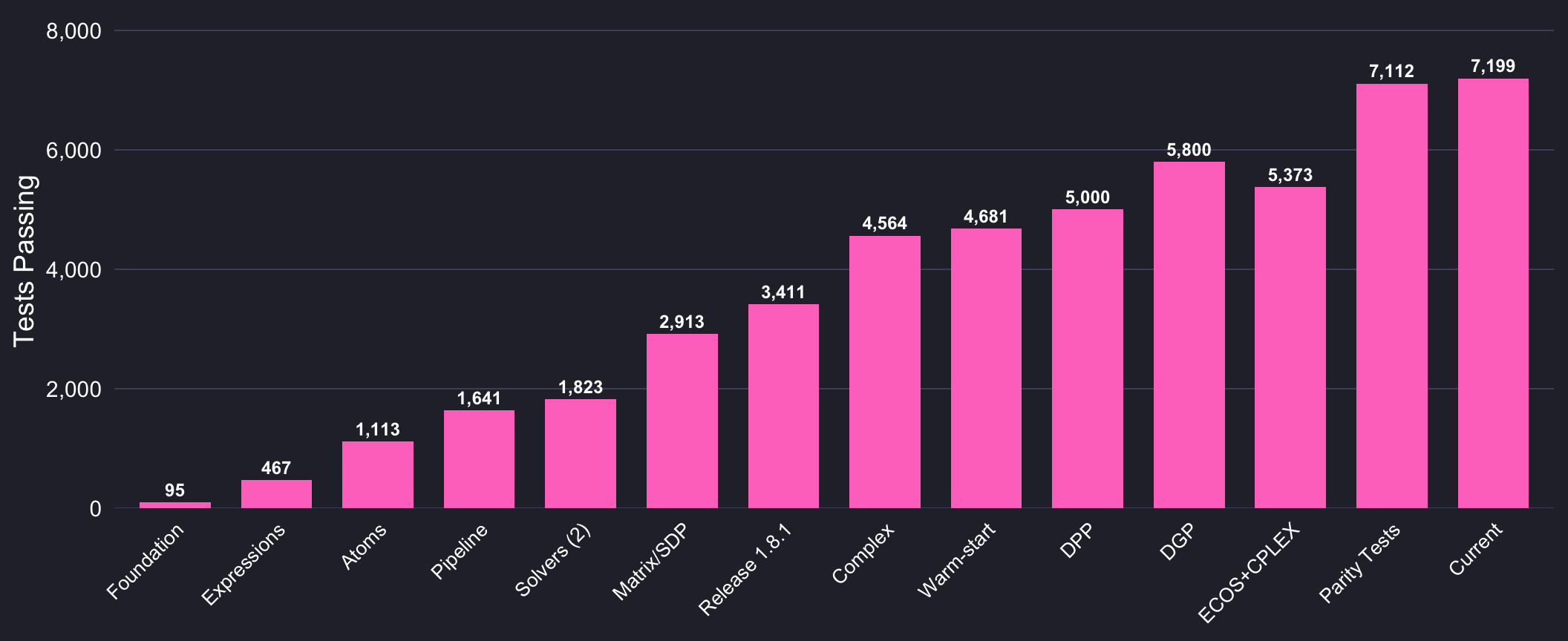
The Journey
Design Choices That Mattered
Structural
- Isomorphic file tree — every CVXPY
.pymaps to an R.Rat the same path - S3 Ops handler for arithmetic (not S7
method()) — handles unary-xcorrectly - C++ bridge unchanged — reuse CVXcanon from old CVXR
Practical
- Cache pattern mirroring CVXPY’s
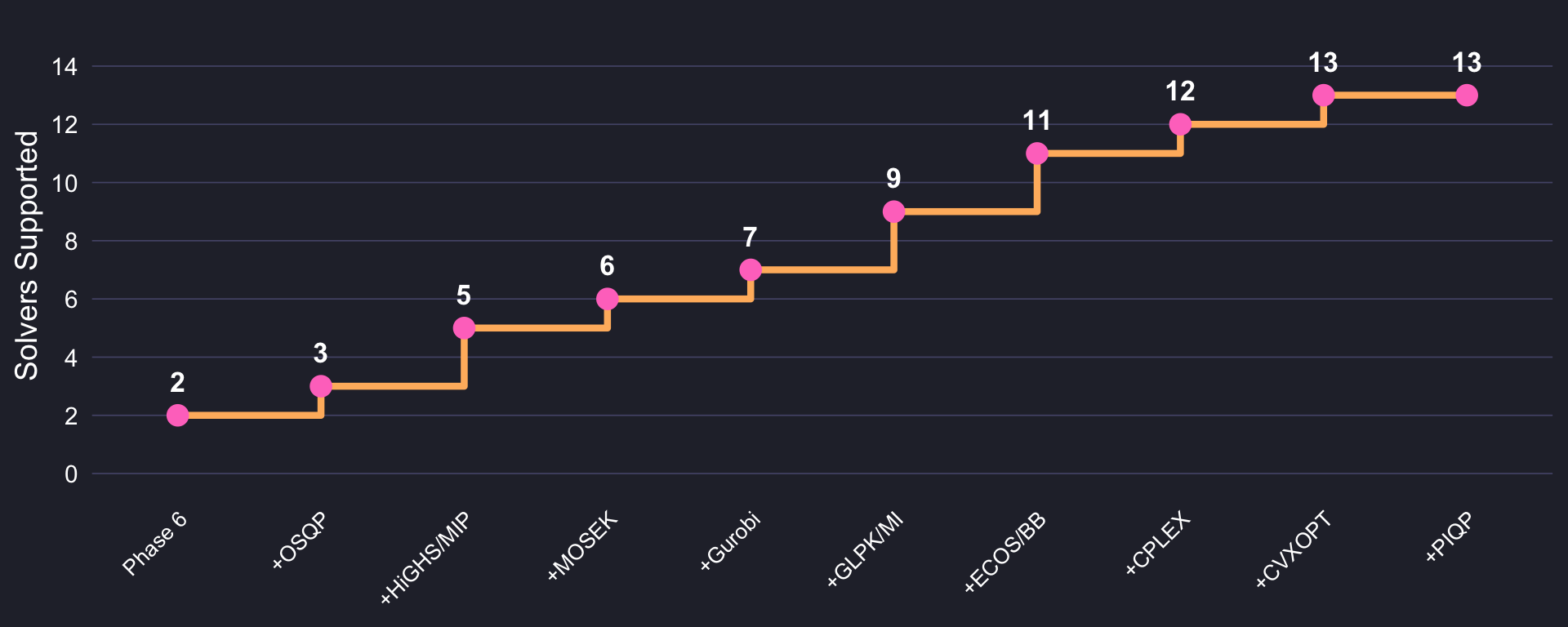
@lazypropwith R environments - Dual sign convention documented per solver (13 solvers, 5 problem types)
- Every decision recorded (150+ in
decisions.md)
Testing Kept Us Honest
3,247 test blocks, each annotated:
Cross-referenced with 1,641 CVXPY tests
Validation scripts to find gaps
Coverage:
| Category | Count |
|---|---|
| CVXPY parity | 514 |
| R-specific | 2,197 |
| Documented N/A | 699 |
| Total | 3,247 |
Solver Progression
Beyond DCP
Features that old CVXR never had:
- DGP — Disciplined Geometric Programming
- Log-space transformations, 6 DGP atoms
- DPP — Disciplined Parameterized Programming
- Tensor-aware C++ bridge, fast re-solve
- DQCP — Disciplined Quasiconvex Programming
- Bisection solver, ceil/floor atoms
- Complex numbers — Full Complex2Real reduction
- 50+ canonicalizers, Hermitian variables
- Warm-start — 7 of 13 solvers
- Logic atoms — Not, And, Or, Xor, implies, iff
- Perspective, FiniteSet constraints
Does it actually work?
Well, let’s see…
The Documentation Website
67 working examples
From basic LP to advanced DGP/DPP/DQCP
All tested. All running. All documented.
What’s in the Docs
Getting Started
- Quick Introduction
- Gentle Introduction
- Basic: LP, QP, SOCP, SDP, MIQP
Regression (9)
- Huber, Logistic, Quantile
- Censored, Isotonic
- Elastic Net, Pliable Lasso
ML & Finance
- Lasso, Ridge, SVM
- Portfolio Optimization
- Kelly Strategy
Applications (14)
- Robust Kalman Filter
- TV Inpainting
- Antenna Array Design
- Channel Capacity
- …and 10 more
Advanced
- DGP: 6 examples
- DPP: 2 examples
- DQCP: 4 examples
Solvers
- Parameters & tuning
- Warm starts
- Speed optimization
- 13 solver configs
By the Numbers
| Metric | Value |
|---|---|
| Expectations passing | 7,199 |
| Failures | 0 |
test_that() blocks |
3,247 |
| CVXPY parity tests | 514 / 1,641 |
| Source files | 246 |
| Solvers | 13 |
| Metric | Value |
|---|---|
| Atoms | 100+ |
| Canonicalizers | 47 |
| Documented examples | 67 |
| Design decisions | 150+ |
3,247 test blocks × ~2 expectations each = 7,199. 514 blocks map 1:1 to CVXPY tests; the rest are R-specific or documented N/A.
Performance: Expression Building
The S4 overhead that plagued old CVXR is gone:
S4 (old)
1.16 min
1,000 variables
2.54 GB memory
S7 (new)
228 ms
1,000 variables
828 KB memory
305x faster. 3,100x less memory.
Performance: End-to-End
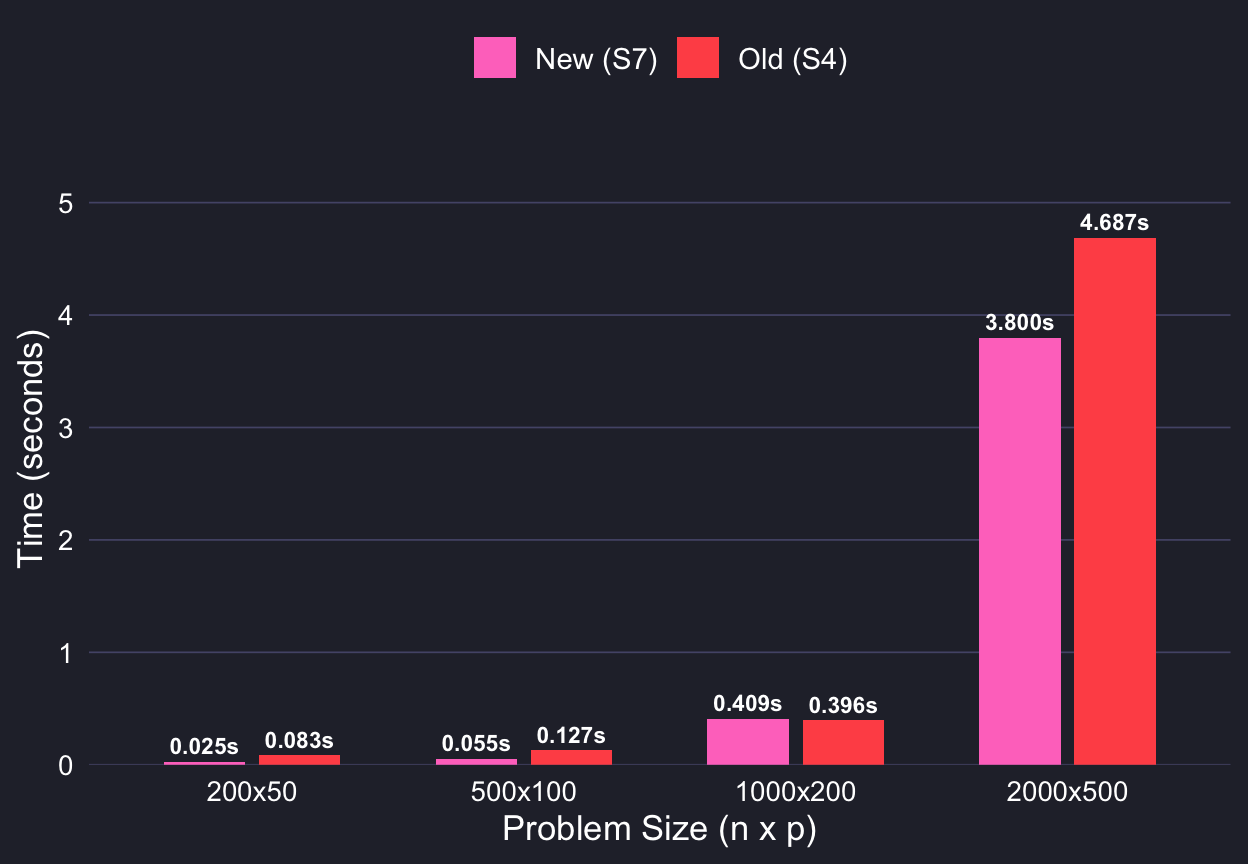
Lasso regression, CLARABEL solver, median of 5 runs:
Build time (problem construction):
| Size | Old (S4) | New (S7) |
|---|---|---|
| 200x50 | 10 ms | 2 ms |
| 500x100 | 8 ms | 2 ms |
| 1000x200 | 8 ms | 2 ms |
| 2000x500 | 9 ms | 2 ms |
5x faster builds, consistent across sizes. Solver time dominates for large problems.
Up to 3.3x faster for small/medium problems. For large problems, solver dominates — which is exactly where you want the bottleneck.
Room to Grow
“Premature optimization is the root of all evil.”
— Donald Knuth
- DPP fast path: parameterized re-solve skips re-canonicalization
- Direct solver calls bypass compilation for repeated solves
- Profiling reveals hotspots (
profvispackage) - We got correct first. Speed comes next.
So… where are we?
v1.8.0-9044
Aligned with CVXPY 1.8.1
Keeping Up with CVXPY
The isomorphic structure isn’t just for the rewrite — it’s the maintenance strategy:
- CVXPY tags a new release (e.g. 1.9.0)
- We pin to that commit in our repo
rsrc_tree/+## CVXPY SOURCE:annotations make diffs obvious- AI-assisted translation of changed files
- Test mapping validates parity
- Repeat
No-regression guarantee:
Every test_that() block is annotated:
If something breaks:
- The annotation tells you which CVXPY test it mirrors
- You run that CVXPY test to see the expected behavior
- The fix is scoped to one file (isomorphic path)
The breadcrumbs lead you straight back to CVXPY’s ground truth.
The same process that built 1.8.1 in 10 days keeps us in sync going forward.
What’s Next
Coming soon:
- CRAN submission (
R CMD checkclean) - Performance optimization pass
- Remaining CVXPY test parity (424 gaps)
- Community feedback integration
Deferred:
- Derivative/sensitivity API (needs R equivalent of
diffcp) - Quantum computing atoms
- Exotic cone fallbacks
We welcome feedback from the CVXPY and CVXR community.
Is this a good plan? Have we overlooked something? Tell us.
What Made This Work
- Standing on giants’ shoulders
- CVXPY’s clean architecture and DCP theory
- 10 years of CVXPY community effort
- Anqi Fu’s astonishing S4 work
- CVXR from scratch to v1.0-15 using S4
- That she got it working at all in S4 was a tour de force
- The design thinking carried forward
- S7 at the right moment
- Finally, an R OOP that maps to Python
- Disciplined architecture
- Isomorphic file structure
- 15 mandatory constraints
- 150+ documented decisions
- Rigorous testing from day one
- CVXPY parity as the north star
- Never move forward with failing tests
- AI-assisted development
- Claude Code for translation + testing
- Human judgment for architecture
- 179 commits in 10 days
Thank You
Links:
- CVXR: github.com/cvxgrp/CVXR
- Docs: cvxr.rbind.io
- CVXPY: cvxpy.org
Contact:
- Balasubramanian Narasimhan
- Anqi Fu
- Stanford University

We welcome your feedback!
Yes, this presentation was also made by Claude — in about an hour, from a one-page brief. It read the git history of 3 repos, ran benchmarks comparing old and new CVXR, synthesized 150+ design decisions, and wrote the typing demo. Even the SVG terminal jokes.

CVXR | Narasimhan & Fu